


Computational Optics Group
exploring the enigmatic reality: unveiling the fusion of classical and quantum worlds in nanoscale light-matter interactions


COLLABORATIONS
EXPERIMENTS
Joshua Hendrickson [AFRL]
Shivashankar Vangala [AFRL]
Adam Dunkelberger [US Naval Research Lab]
Blake Simpkins [US Naval Research Lab]
Lev Chuntonov [Technion]
Wei Xiong [UCSD]
Shivashankar Vangala [AFRL]
Adam Dunkelberger [US Naval Research Lab]
Blake Simpkins [US Naval Research Lab]
Lev Chuntonov [Technion]
Wei Xiong [UCSD]
THEORY
Abraham Nitzan [UPenn, Tel Aviv University]
Andrei Piryatinski [LANL]
Joseph Subotnik [Princeton]
Angel Rubio [Max Planck]
Andrei Piryatinski [LANL]
Joseph Subotnik [Princeton]
Angel Rubio [Max Planck]
FUNDING


RESEARCH HIGHLIGHTS
Efficient numerical tool for integrating Maxwell-Schrödinger equations in three dimensions on supercomputers
New parallelization approach to simulate optical properties of ensembles of quantum emitters in realistic electromagnetic environments is proposed. It relies on balancing computing load of utilized processors and is built into three-dimensional domain decomposition methodology. Proposed approach enables directly accessing dynamics of collective effects as a number of molecules in simulations can be drastically increased. Numerical experiments measuring speedup factors demonstrate the efficiency of the proposed methodology. As an example, we consider dynamics of nearly 700,000 diatomic molecules with ro-vibrational degrees of freedom explicitly accounted for coupled to electromagnetic radiation crafted by periodic arrays of split-ring resonators and triangular nanoholes. As an application of the approach, dissociation dynamics under strong coupling conditions is scrutinized. It is demonstrated that the dissociation rates are significantly affected near polaritonic frequencies.

Molecular plasmonics simulations. Panel (a) shows two electronic potential energy surfaces as functions of the internuclear distance. Vertical dashed line shows the value of the vertical gap, which is set to match the localized SPPR of the plasmonic system. The geometry of simulations is depicted in the inset of panel (b), where the molecular layer shown in blue is placed on top of the PVA layer covering SRRs. The main panel (b) shows absorption as a function of the incident frequency without molecules (black) and with molecules at different molecular concentrations: (red) 8×1025 m-3, (blue) 1026 m-3, and (green) 2×1026 m-3.

Collective dissociation dynamics at plasmonic interfaces. The inset in panel (a) shows a periodic array of triangular holes in 350 nm thin Au film on a glass substrate (refractive index is 1.52). The system is periodic along X and Y with a period of 350 nm. The triangular hole is in a shape of an equilateral triangle with a side of 230 nm. Molecular layer is placed on top of the metal film and is 18 nm thick.
Panel (a) shows absorption as a function of frequency for the array without molecules (black line) and with molecules (red line) Panel (b) shows an ensemble average internuclear distance calculated using Eq. (8) for molecules in vacuum (black line) and on the metal film (red line). Vertical blue dashed lines show polaritonic frequencies.
Total number of molecules is 691,200
Total number of processors used 1536
Codes combine EM dynamics at plasmonic interfaces with quantum dynamics of molecules with ro-vibrational degrees of freedom
Total number of processors used 1536
Codes combine EM dynamics at plasmonic interfaces with quantum dynamics of molecules with ro-vibrational degrees of freedom


Unveiling the dance of molecules: ro-vibrational dynamics of molecules under intense illumination at complex plasmonic interfaces
Understanding the quantum dynamics of strongly coupled molecule-cavity systems remains a significant challenge in molecular polaritonics. This work develops a comprehensive self-consistent model simulating electromagnetic interactions of diatomic molecules with quantum ro-vibrational degrees of freedom in resonant optical cavities. The approach employs an efficient numerical methodology to solve coupled Schrodinger-Maxwell equations in real space-time, enabling three-dimensional simulations through a novel molecular mapping technique. The study investigates relaxation dynamics of an ensemble of molecules following intense resonant pump excitation in Fabry-Perot cavities and at three-dimensional plasmonic metasurfaces. The simulations reveal dramatically modified relaxation pathways inside cavities compared to free space, characterized by persistent molecular alignment arising from cavity-induced rotational pumping. They also indicate the presence of a previously unreported relaxation stabilization mechanism driven by dephasing of the collective molecular-cavity mode. Additionally, the study demonstrates that strong molecular coupling significantly modifies the circular dichroism spectra of chiral metasurfaces, suggesting new opportunities for controlling light-matter interactions in quantum optical systems.
FIGURE. Linear absorption spectra for three metasurfaces with molecules: (a) TH holes, (b) split-ring resonator holes, (c) chiral split-ring resonator holes. Dash-dotted lines in each panel show absorption without the molecular layer and solid lines present absorption with molecules.

Molecular polariton dynamics in realistic cavities
The large number of degrees of freedom involved in polaritonic chemistry processes considerably restricts the systems that can be described by any ab initio approach, due to the resulting high computational cost. Semiclassical methods that treat light classically offer a promising route for overcoming these limitations. In this work, we present a new implementation that combines the numerical propagation of Maxwell's equations to simulate realistic cavities with quantum electron dynamics at the density functional tight-binding (DFTB) theory level. This implementation allows for the simulation of a large number of molecules described at the atomistic level, interacting with cavity modes obtained by numerically solving Maxwell's equations. By mimicking experimental setups, our approach enables the calculation of transmission spectra, in which we observe the corresponding polaritonic signals. In addition, we have access to local information, revealing complex responses of individual molecules that depend on the number, geometry, position, and orientation of the molecules inside the cavity.

Interference-Induced Complex Nonlinearities in Metal-ITO Metasurfaces
We combine modeling and experiments to investigate second- and third-harmonic generation (SHG/THG) in metal-indium tin oxide (ITO) metasurfaces. Linear optics at normal incidence show moderate field enhancement near the ITO epsilon-near-zero (ENZ) wavelength, steering the focus toward intrinsic, material driven nonlinear response rather than simple linear field boosting. Wavelength resolved SHG requires a Lorentz-dispersive chi(2) for ITO to match spectra; a static chi(2) fails. Angle-resolved SHG/THG cannot be reproduced with purely real coefficients; grouped contributions to chi(3) (and effective chi(2)) must be complex. Using a hydrodynamic model for the metal and ITO with linear dispersion plus dispersive chi(2) and chi(3), we show that these complex phases arise from coherent interference of nonlinear sources in the metal, ITO, and interfaces, each weighted by distinct, complex local field and radiation factors. Experimentally, we fabricated split-ring resonator metasurfaces on ITO films atop a metallic ground plate and measured linear reflectance and angle-resolved SHG/THG in reflection geometry. The measurements quantitatively confirm the modeling: dispersive chi(2) is necessary to capture SHG spectra, and complex, interference-induced effective coefficients are essential to reproduce angular SHG/THG patterns. Together, these results provide a unified, physically grounded interpretation of nonlinear emission from metal-oxide metasurfaces without relying on ENZ field enhancement.

Experimental setup and sample architecture. (a) The reflection-geometry for nonlinear microscope used for SHG/THG measurements. Linear measurements were performed with a commercial FTIR. A femtosecond laser is polarization-conditioned with a half-wave plate (HWP) and linear polarizer (LP), directed through a dichroic mirror (DC), and focused onto the metasurface with a 10x, 0.26 NA objective. The generated harmonics are collected by the same objective, pass a short-pass filter (SPF) to block the fundamental, cleaned by an analyzing LP, and are sent to a spectrometer. (b) Schematics of the metasurface: gold split-ring resonators (SRRs) patterned on an indium–tin-oxide (ITO) film deposited atop a gold ground plate on a substrate
Collective Rabi-driven vibrational activation in molecular polaritons
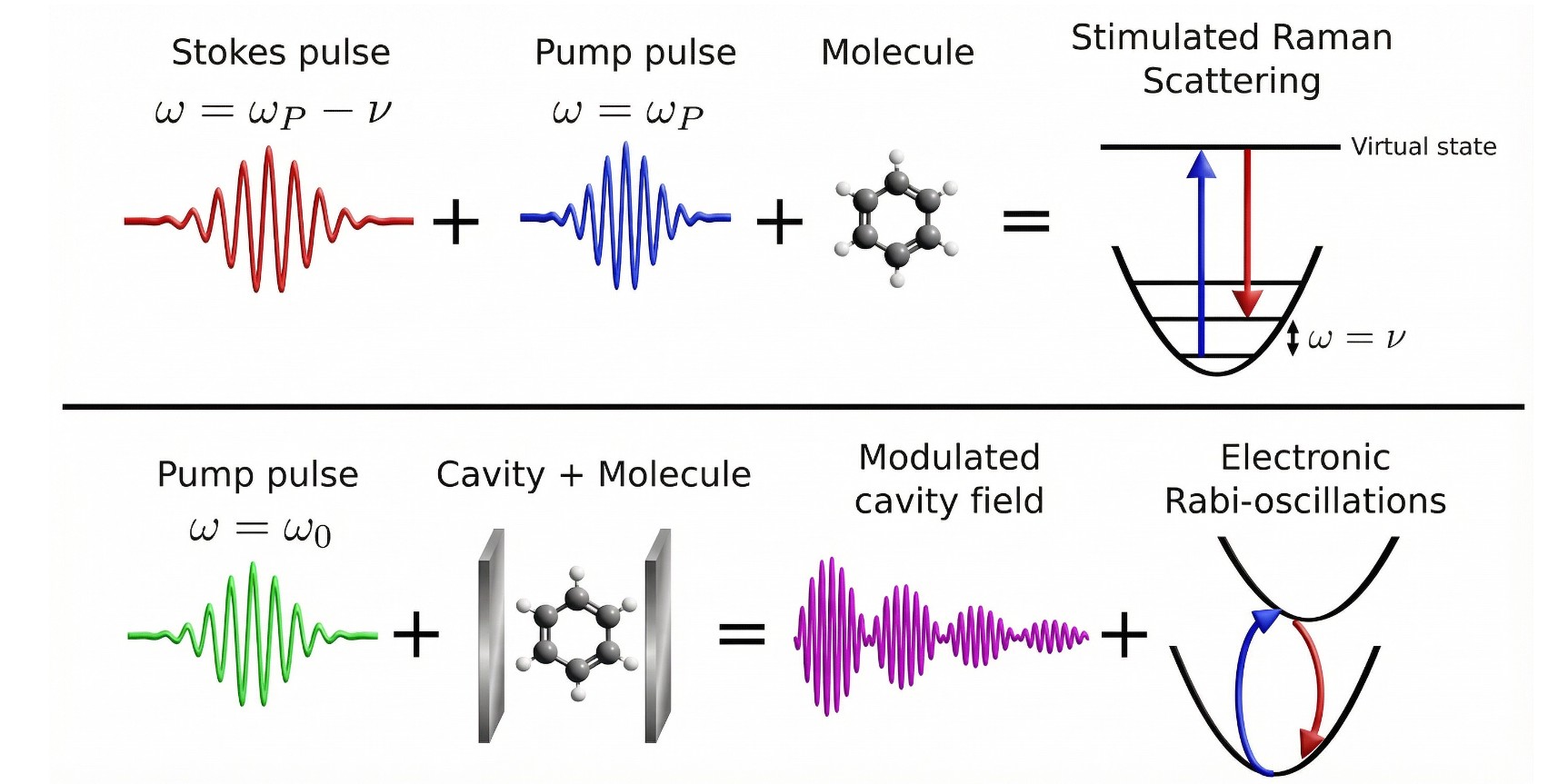
Hybrid light–matter states, known as molecular polaritons, arise when a molecular excitation strongly couple to confined electromagnetic fields. While electronic and vibrational strong coupling (ESC and VSC) have been extensively explored, the influence of electron–nuclear dynamics under externally driven cavities remains largely unknown. Here, we report a previously unrecognized mechanism of vibrational activation that emerges under ESC in driven optical cavities, governed by collective light–matter interactions. Using semiclassical simulations that self-consistently combine Maxwell’s equations with quantum molecular dynamics, we show that electronic Rabi oscillations associated with the collective polaritonic splitting coherently drive nuclear motion. We employ two complementary approaches: vibrational wave-packet dynamics on Born–Oppenheimer surfaces in a minimal two-level model, and atomistic simulations based on time-dependent density-functional tight-binding with Ehrenfest nuclear dynamics. Vibrational amplitudes depend non-monotonically on the Rabi frequency, peaking when the collective Rabi splitting resonates with a molecular vibrational mode. This Rabi-driven activation is analogous to a damped harmonic oscillator under periodic driving, exhibits pronounced mode selectivity, and is controlled by cavity losses and mode structure, consistent with a stimulated Raman-like relaxation mechanism. Beyond revealing this collective vibrational pathway, our results establish a self-consistent framework for coupling realistic cavity electrodynamics to atomistic electron–nuclear dynamics, opening avenues for quantitative control of molecular degrees of freedom in polaritonic systems. (https://doi.org/10.1021/acs.nanolett.6c00832)
Universal scaling and many-body resurrection of polaritonic double-quantum coherences
The ultrafast nonlinear optical response of molecular ensembles is fundamentally altered under strong light-matter coupling. To rigorously isolate the genuine many-body contributions, an exact time-domain field-subtraction protocol is developed within a fully non-perturbative Maxwell-Liouville framework explicitly incorporating the two-exciton manifold in real space and time. This approach reveals that while collective cavity delocalization drives the macroscopic nonlinear signal toward a severe harmonic cancellation (an effect termed "spectral starvation"), intrinsic many-body molecular interactions robustly resurrect genuine polaritonic double-quantum coherences (DQCs). This many-body resurrection is governed by a universal two-photon matching rule, $\Delta_B+4J=\Omega_R$, linking molecular anharmonicity ($\Delta_B$) to the macroscopic Rabi splitting ($\Omega_R$) and excitonic coupling (J). Crucially, this resonance exploits the spatial mismatch between macroscopic polaritons and localized two-exciton pairs to break harmonic cancellation. For J-aggregates (J < 0), this condition uniquely isolates the resonant many-body state below the dense manifold of localized dark states, protecting the macroscopic coherence from spatial fragmentation. This predictive framework establishes a direct phase diagram to engineer and protect optical nonlinearities across diverse strongly coupled platforms. https://arxiv.org/abs/2604.03423v2
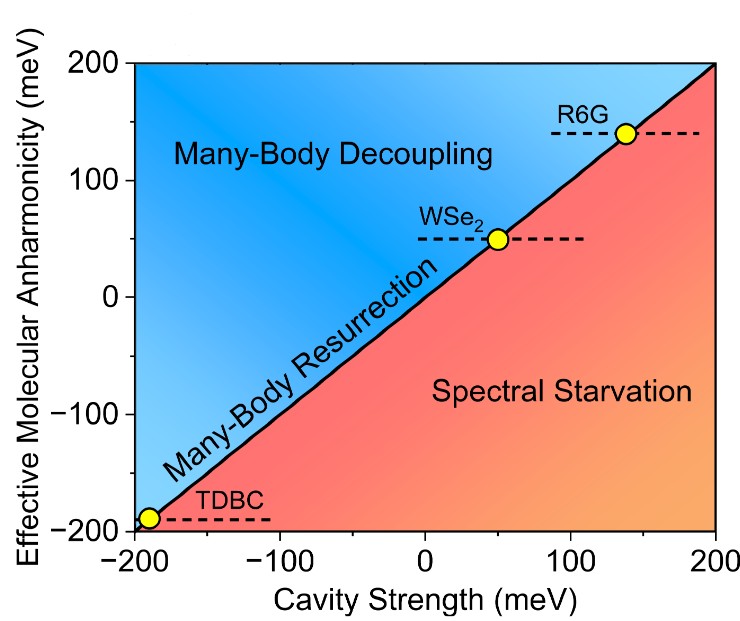
Universal phase diagram for the many-body response. The boundary $\Delta_B+4J=\Omega_R$ defines the "Many-Body Resurrection" where intrinsic molecular interactions balance cavity-induced delocalization. Regions of Spectral Starvation (harmonic regime) and Many-Body decoupling (localized regime) are indicated. Representative materials (TDBC, WSe2, and R6G) are mapped along their respective tuning trajectories (dashed lines) with yellow markers identifying the optimal resonance points.